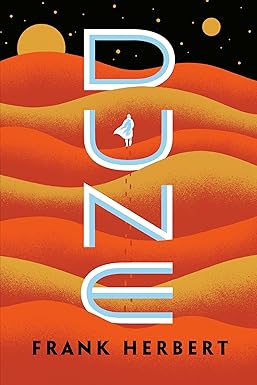
Dune by Frank Herbert Review
4.7 / 5
Overall Rating
Dune
Dune is the 1965 Frank Herbert classic that Denis Villeneuve adapted into Dune (2021) and Dune: Part Two (2024). We reviewed the source material for film fans.
- 704-page 40th Anniversary paperback edition
- Source novel behind the Dune films
- Owned copy, read offline with no streaming
We may earn a commission if you make a purchase through our links.
Pros
- 704-page 40th Anniversary paperback edition
- Source novel behind the Dune films
- Owned copy, read offline with no streaming
- Sci-fi classic from Penguin Publishing Group
Cons
- Paperback binding, not hardcover
- Single novel, not the full series
Few sci-fi novels have the cultural staying power of Frank Herbert's Dune (1965). Denis Villeneuve's 2021/2024 film adaptations renewed interest among a generation that hadn't read the book. The paperback ($10, 4.7 stars, 102,000+ reviews) is the source material — we reviewed it for film-fans wanting to engage with what Herbert actually wrote.
TL;DR
The right sci-fi entry for fans of the Villeneuve films wanting deeper world-building. 1965 Hugo + Nebula award winner; the foundational space opera that influenced Star Wars, Game of Thrones, every desert-planet story since. Pair with Dune Messiah (book 2). Skip if you only enjoy the films and want to keep them as the experience.
Why It Matters
Dune is the source for an entire genre lineage. Star Wars borrowed heavily (desert planet, mystic order, evil empire). Game of Thrones inherited the political-intrigue + multiple-POV structure. Foundation, Hyperion, even modern hard sci-fi like The Expanse trace ancestry to Dune.
For Villeneuve film viewers, the book provides what films can't: Paul Atreides' internal monologue, the Bene Gesserit's full historical scope, the Mentat tradition's depth, the Fremen culture's daily-life detail. The film captures the visual scope; the book captures the intellectual scope.
Key Specs
- Author: Frank Herbert (1920-1986)
- Series: Dune Chronicles #1 (of 6 by Frank; 20+ by Brian Herbert + Kevin J. Anderson)
- Pages: 688 (paperback)
- Original publication: 1965
- Format: Paperback (Kindle, hardcover, audio also)
- Awards: Hugo Award (1966), Nebula Award (1965)
- Setting: Arrakis (desert planet), 10,191 AG
- Reading time: ~16-20 hours
- Film adaptations: 1984 (David Lynch), 2021 (Denis Villeneuve, Part 1), 2024 (Villeneuve, Part 2)
Pros
- Foundational sci-fi text. Genre-defining; cultural impact for 60 years.
- Multi-POV political intrigue. House Atreides vs Harkonnen complexity.
- Deep world-building. Spice, sandworms, Bene Gesserit, Mentat, CHOAM — all interconnected.
- Religious + mythic resonance. Paul's Messianic arc; Fremen prophecy interpretation.
- Hugo + Nebula winner. Genre recognition.
- Dense without being inaccessible. Glossary in back helps; not academic prose.
- Series depth. 5 more Frank Herbert sequels if hooked.
Cons
- 688 pages. Commitment vs Villeneuve's 5-hour total film runtime.
- Slow opening 100 pages. Setup-heavy.
- 1965 prose feels dated to some. No modern hooks.
- Italicized internal monologue is divisive technique.
- Some readers prefer films. Visual scope is what Villeneuve adds.
- Dune Messiah ending. Many readers stop after book 1; book 2 is divisive.
Who It's For
- Villeneuve film fans wanting source material depth.
- Sci-fi readers ready for foundational text. After modern hooks (Andy Weir, Becky Chambers).
- Genre-influence trackers. Star Wars / GoT / Foundation lineage.
- Long-form readers. 700+ pages.
- Series committers. 6-book Frank Herbert run.
- Audiobook listeners. Multiple narrator versions; the 2007 Scott Brick version is widely-recommended.
- Skip if you only enjoy Villeneuve's films and don't want them refracted through Herbert's prose, if 700-page books exhaust you, or if you found the 2021 film slow (the book is slower).
How to Use
- Read after watching Dune (2021) film, ideally before Part Two
- Use the glossary in back of paperback for unfamiliar terms (Kwisatz Haderach, etc.)
- Don't research book 2's ending — Dune Messiah's reveal is best fresh
- Watch David Lynch's 1984 Dune for adaptation comparison (skipped by most modern viewers)
- Pair with Children of Time (Tchaikovsky), Hyperion (Simmons), or Foundation (Asimov) for genre breadth
How It Compares
- vs Villeneuve Dune Films (Blu-ray): Films capture visual scope; book captures intellectual scope. Own both for completeness.
- vs Dune Messiah (Book 2) ($10): Direct sequel. Divisive ending; some readers stop after book 1. Worth reading for series resolution.
- vs Foundation (Asimov): Comparable foundational sci-fi. Different premise; pair them.
- vs Hyperion (Simmons): Comparable space opera with literary scope. Pair for sci-fi breadth.
- vs Children of Time (Tchaikovsky): Modern hard sci-fi; comparable themes (evolution, civilization scope). Different setting.
- vs Star Wars novels: Star Wars borrowed Dune themes. Pick Dune for source.
Bottom Line
Dune by Frank Herbert is the right source-material companion for Villeneuve film fans + the foundational text for sci-fi readers. Hugo + Nebula winner, multi-POV political intrigue, deep world-building. Foundation and Hyperion are comparable genre-foundational picks; Children of Time is the modern hard sci-fi continuation. For "the sci-fi novel that defined a genre," this earns the slot at $10.
Streaming Service Cost Optimizer
Google Sheet template that calculates your true cost-per-hour watched across Netflix, Hulu, HBO Max, Disney+, and more. Find which services are actually worth keeping.
Average user saves 23 dollars per month
Instant download. No spam. Unsubscribe anytime.
Affiliate Disclosure
Discussion
Sign in with GitHub to leave a comment. Your replies are stored on this site's public discussion board.